Showing posts with label Academia. Show all posts
Showing posts with label Academia. Show all posts
27 April 2014

07 March 2014
senior integration
While
I have continued to work on my SIP regularly, I find myself in a struggle to
keep up hope in finishing it to my satisfaction. I become overwhelmed faster
and for longer periods of time as I come to learn more about the souls of my
characters. They are beautiful, broken, frightened people and my strong desire is to represent them both respectfully and holistically.
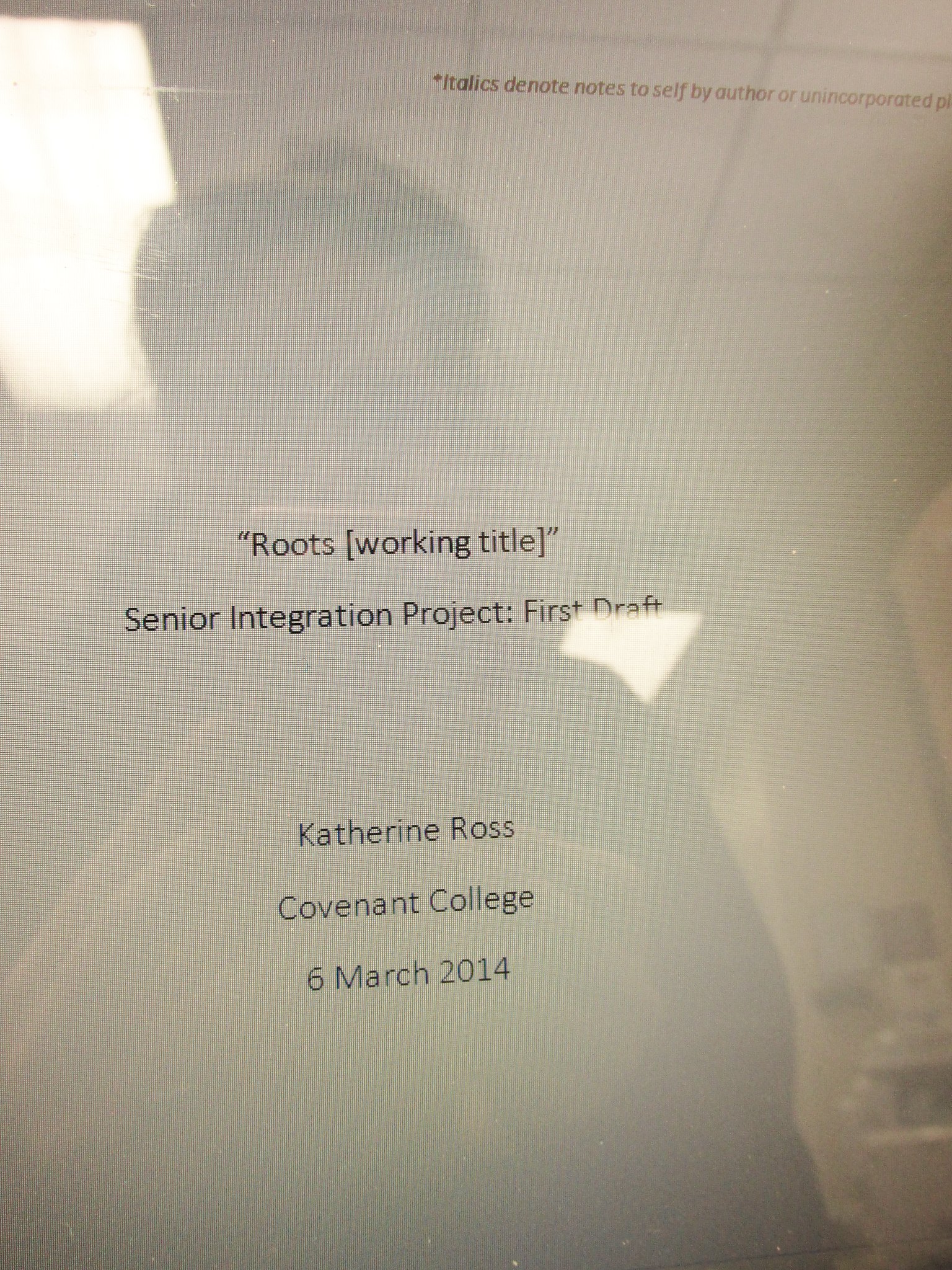
I am still reading Anne Lamott's Bird by Bird and her honesty about the terror of the "sh---- first draft" couldn't have come at a better time.
It is a wonderful reminder of how I am in good company in my struggles. I may feel as though this entire paper is falling apart (which usually expands into the fear that this real, physical, grab-the-dirt-between-your-fingers-world is also falling apart), but that is part of the writing
process. The horrible dialogue that I wrote? The sentimental moment Lawrence had the other day? No one will ever read or see that unless I want them to. If I allow those drafts to come into being knowing that they are disgusting and messy, if I work through them later after leaving them sit raw and trembling for awhile, they become harder, firmer, more temporal, and more truthful than I care to admit. And what better goal could I have in this almost-but-not-yet?
What
I am really concerned about is my perfectionism. Once again, Anne Lamott blows
me away by speaking directly to the fears that have built their way up around
me. The piece I am writing turns out to be sitting right next to many wounds I
never knew existed. I have hid them away for so long that I forgot they lie there, all stretched out and tender...until I begin writing. Suddenly, it’s all too close and I can’t put down another word for fear that it will be sharper than the last. Every muscle around those nerves, the nerves I need access to for a
particular scene or expression, are cramped and inflamed, refusing to respond. So I
try to force my way through the barbs only to find myself with more abrasions. I
can hardly look at the pages on my computer screen, much less think about
reading them aloud.
But then it begins to loosen. After jumping about like mad tweaking a word on page ten and maybe switching a couple on page twenty three, I begin to feel the first scene open up again. I start to hear his breathing get louder and faster, or I see the glint of light off of her zipper pull. I dive back in for half an hour and come out panting, twitchy, and in no condition to attend to my next class. Thank you, Father God for acting step-outs and prayer to wipe away the tension.
I have also found someone to read my drafts as I go along...the bloated, red, puffy ones along with the tinny lies of inaccurate dialogue. It is a terrifying thing to ask for such censure and it takes an extremely rare pairing of great love and clear vision to be a friend and a critic, but I have found just such a one. She herself is fully aware of how close writing is to the soul and how gentle yet sharp criticism must be. I am greatly blessed.
As of today I have nineteen scenes written in first, second, or third draft form and I have thirteen scenes sketched out in some degree of detail. There are now less than seventy days before this piece will have to go under the false title of "final draft," but I can’t think about that.
I feel overwhelmed and scared but I am also absolutely certain that this is what I need to be writing and doing and thinking and feeling.
12 February 2014
propitiation
This is a reflection piece I wrote for my current doctrine class.
My
understanding of the gospel has always included propitiation. Having grown up Presbyterian, the holy wrath
of God has always held great sway over my theology and has skirted around
nearly ever sermon. Yet, it has always been balanced with the great and
wonderful idea of propitiation laid out in Romans 3:23-25 which declares that
“For all have sinned and fall short of the glory of God,
and are justified by his grace as a gift, through the redemption that is in
Christ Jesus, whom God put forward as propitiation
by his blood, to be received by faith.”
Propitiation has always been the one great act that freed
my soul from the crush and horror of my sinful nature. D. M. Lloyd Jones
explores this idea in his work Romans [1]. He
declares Romans 3:25 to be one of the most important verses in scripture
because it fleshes out the method of salvation and why it had to happen the way
it did. He goes on to explicate the publicity in which Christ died and the
message that His life and death project out to the world. Yet, as I read
further, I was hit by not only the depth of importance carried by the doctrine
of propitiation, but also the breadth of time that it covers and the
intentionality of each day’s salvation.
This expansion of my
understanding was triggered by the assigned reading of J.I. Packer’s book In My Place Condemned He Stood. In the
chapter entitled “The Heart of the Gospel,” Packer details the doctrine of
propitiation, showing how Christ is not only a one time propitiation for our
sins, but also how He is making
propitiation for us in this very moment in the presence of the Father. The
verse which Packer used to introduce this idea is 1 John 2:1b-2:
“…we have an advocate with the Father, Jesus Christ the righteous. He is
the propitiation for our sins, and not for ours only but also for the sins of
the whole world.”
The phrase that leapt out at me from this verse is “we
have.” It rings in the present tense and, despite Paul writing centuries ago,
we can still grasp hold of the significance of his word choice. Christ has not
yet returned and we continue on in the almost-but-not-yet. Such present tense
means that not only did Christ become our propitiation, but that He continues
to be active in that role. Packer, later in the chapter referenced above, lists
“action” as a driving force in Christ’s life. It is the same in the doctrine of
propitiation.
Anthony
Carter adds to the discussion as he laments how infrequency Christians talk
about propitiation on a daily basis when it is in fact the foundation of our
faith [2]. He
grapples heavily with the wrath of God and the importance of our understanding
it in order to better understand His Holiness. Yet, it is that very wrath which
opens to us a fuller understanding of what it means to be atoned for–to have
someone actively choose to be our propitiation.
Christ is not simply sitting on
his laurels, passively watching his work save humanity and secure eternity for
His children; He is speaking and living on our behalf day after day, ushering
us into salvation one by one by stripping us of our sin and wrapping us in His
own perfection.
[1] Lloyd-Jones, D.
M. Romans: An Exposition of Chapters 3.20-4.25
Atonement and Justification. “Propitiation.” Grand Rapids: Zondervan, 1976.
65-80. Print.
[2] Carter, Anthony
J. Blood Work. “Propitiation by the
Blood.” Orlando: Reformation Trust, 2013. 23-31. Print.
05 February 2014
bird by bird
Reading
Anne Lamott’s Bird by Bird for the
first time, I feel as though I am no longer alone. Suddenly there is someone
else who rocks as she writes, who struggles to tear the words away from her
demons, and who can barely hear her characters over the buzzing.
As
she talks about her love and fear of writing, I remember the reasons I began
writing in the first place and why I have continued. I am writing a creative
piece for my SIP because I want to have a piece of work that speaks for me. I
want to wrestle the truth to the ground and perhaps find others who are
flailing under the same burdens. I want to feel that “sense of larger
significance, of meaning” (Lamott xix).
She
proceeds through her writing process nearly exactly as I do beginning with
overheard tidbits, turning details around in your mind, and then gritting your
teeth through the much-dreaded actual writing. The value of her father’s
advice, to write “by prearrangement with yourself” (xxii), has become so clear
to me these past two weeks. I have carved out six hours every week to work on
campus and add more on weekends if I can. Working in two hour blocks keeps me
from becoming scattered and hopeless under the size of the task. Suddenly you just have to show up every day.
You no longer have to fill your head with the entire story or the yells of all
your characters at once; you need only see and describe one room or one feeling
at a time. Suddenly, finishing this piece seems doable; maybe it won’t destroy
me.
Another
truth Lamott includes is that “the act of writing is its own reward” (xxvi).
Simply by working through all of the details of crawling into someone else’s
skin, I can glorify the Lord and bring Him pleasure. All I have to do is keep
moving forward.
Still,
there is the great struggle I face and which is not brushed off lightly here,
which is that writing “will not make [you] well” (xxx). I so often find myself
at the end of a draft, desperate to feel healed and rejuvenated only to
discover that it has simply stirred the dirt up inside of me more than before.
But, that is okay. Just because I do not find peace in this does not mean that
I am wasting my time. So long as my “writing is about telling the truth,” I
will succeed (3).
Another
piece of the puzzle is that “you own what happened to you” (6). True, my piece
is fiction, but it is also deeply imbedded in my emotional psyche and so
grounded in the tangle of truth, lies, and sin that is my own life, that I must
understand the importance of accepting the responsibility for what I am saying
as well as knowing that what I am saying is true. In the end, it doesn’t matter
what other people think of it.
More
than anything I want to make people notice…to see these people as they are,
broken and desperate and beautiful. They may not understand them, but I want
others to at least see them and acknowledge them. They may not exist in
reality, but their realistic molds have formed many like them.
30 January 2014
word love
"Mother starts to recite a poem. 'I remember, I remember, the house where I was born...' She says it straight through, and I tag beside her watching the trees walk past in the sky." Laurie Lee's "Cider for Rosie"
"Mile after rattling mile we went, under the racing sky, flying neckties and paper kites from the back, eyes screwed in the weeping wind." Laurie Lee's "Cider for Rosie"
"...my head ringing with sleep." Laurie Lee's "Cider for Rosie"
"Mile after rattling mile we went, under the racing sky, flying neckties and paper kites from the back, eyes screwed in the weeping wind." Laurie Lee's "Cider for Rosie"
"...my head ringing with sleep." Laurie Lee's "Cider for Rosie"
29 January 2014
pounding in my head
I am writing a creative piece for my senior paper. My goal is, by using small, concrete details, to build the story around the two main figures in such a way as to show how their fear is both understandable and destructive. A lofty goal, but one I am struggling to achieve. I long to make these characters true. I want to be honest with my readers about those sins which lurk in my own body and project through these people...how brokenness tears people apart when it could bring them together.
The process has been long, exhausting, and endlessly rewarding. I may spend hours struggling over one concept and then days walking tenderly, careful to not touch the raw parts of my psyche. But I wouldn't change it.
Each draft transforms me.
No one can write or tell a story perfectly. Let it be that I wrote one truthfully for that may be the highest possible goal in this almost-but-not-yet.
The process has been long, exhausting, and endlessly rewarding. I may spend hours struggling over one concept and then days walking tenderly, careful to not touch the raw parts of my psyche. But I wouldn't change it.
Each draft transforms me.
No one can write or tell a story perfectly. Let it be that I wrote one truthfully for that may be the highest possible goal in this almost-but-not-yet.
27 January 2014
welcome. let me feed you.
I wrote this sketch last semester for a literature final. The class covered Romanticism and the outpouring of new ideas and publications during that period. They were such fascinating people, many of them unafraid of opening their inner lives to readers. Or had those inner lives waved about by the public whether they wanted it or not. Either way, they were quite an eccentric group of folks that I greatly enjoyed getting to know over the semester. And, as there are few things I enjoy more than listening and sitting people down to eat together, this piece was just waiting to happen.
As I lit the last pillar candle and
straightened the last fork, I surveyed the table spread: simple, yet
overflowing with vegetable dishes of all sorts. The Shelleys were still on
their vegetarian kick, and Percy always gave the same impassioned ramble of a
speech anytime he saw one of his friends consuming meat.
Just as I stepped back into the kitchen
to check on the pies, a commanding rap jostled the CD player, starting Mozart’s Requiem over again. With that much concentrated energy, it could only be Blake.
Hurrying across the wood floor in my stocking feet, I slid to the latch,
composed myself, and threw open the door.
“I come to discover before Heaven and
Hell the self-righteousness in all its hypocritical turpitude” (“Milton A Poem” 198).
And with such an entrance as was typical for him, Blake stepped onto the carpet
and made his way into my apartment. Somewhat desperate to not be alone with
Blake what with the heavy weight of trying to understand the depth of nearly
everything he says, I hesitated before losing the door, providing just enough
time for Hannah More to bustle around the corner and up my front steps, quickly
followed by the Shelleys. My small apartment was quickly filled with talk and
chatter as cloaks, hats, and walking canes were set aside.
As I closed the door, I glanced around
it hoping to glimpse the Wordsworth siblings, but no such luck. It wasn’t until
appetizers were dwindling that Dorothy Wordsworth’s timid knock announced their
arrival.
“I’m sorry we’re late,” she said as they
stepped in. “We…went to John’s Grove [and] sat awhile at first (“The Grasmere
Journals” 497). It’s ever such a beautiful day. We got lost in it.” The whole
party welcomed them in as I set the latch behind them and gestured toward the
table. I pointed out the neatly lettered place cards in the hope that they
would follow my carefully planned seating arrangement. However, despite my best
efforts, Percy sat directly next to Wordsworth, taking the head of the table.
As the evening progressed and the food
slowly disappeared, a lull in the conversation prompted me to talk of the
weather. “It’s been quite lovely today, hasn’t it?” I said eager to restart the
conversation along with a new round of potatoes.
“The
morning sun shone bright and warm,” Wordsworth said, as he rolled asparagus
onto his plate (“Anecdote for Fathers” 205).
“Indicative of a happy evening, I’m
sure,” trilled Mary Shelley over the cranberries. She was always on about the
weather foreshadowing the future emotions of whoever was about.
“Oh!” Hannah More perked up her head. We
all waited for he to whip out her pet issue and wave the slave ship in our
faces, but, much to our relief, she continued one of our previous conversations
on the meaning of art and sensibility. “I’ve been thinking about how art can
never seize, nor affection catch thy power to please’ and we tall about sensibility
and its “keen delight,” but how do we begin to define it?” (26).
“Well…” Percy swallowed the roll in his
mouth and began. “It’s all wrapped up in nature, really.” Gesturing towards the
Cascade Mountains filling the window in front of him, he raised his voice and
declared, “The naked countenance of earth on which I gaze, even these primeval
mountains teach the adverting mind” (“Mont Blanc” 859). I leaned forward to
look around Dorothy and Blake towards the window revealing the fresh snow laid
out on the clustered peaks. They were certainly impressive.
Percy continued. “If we’re open to
nature it will teach us truth. That’s what you used to think, eh Wordsworth?”
The bite in his voice cut through my visions of a conflict-free evening. I
should have known better than to expect an evening with strong-minded artists
to be smooth.
Wordsworth shifted his shoulders and
looked uncomfortable. “‘…I [am] still a lover of the meadows and the woods and
mountains, and of all that we behold from this green earth, of all the mighty
world of eye and ear…well-pleased to recognize in nature and the language of
the sense, the anchor of my purest thoughts, the nurse, the guide, the guardian
of my heart, and soul of all my moral being’ (“Prelude” 240). Truth is surely
communicated through nature, but that Truth is God, not nature itself.” The
whole party sat quiet for a moment as Percy softly shook his head.
Breaking the silence, he said, “‘Though
leavest me to grief, thus having been, that thou shouldst cease to be’ the
‘poet of nature’” (“To Wordsworth” 852). Several more beats of silence followed
his words, punctuated by Blake’s knife cutting through the maple carrots. Blake finally broke it.
“Well, If thought is life and strength
and breath; and the want of thought is death; then am I a happy fly, if I live,
or if I die” (“The Fly” 27). Once again he was making a comment that sounded to
the point, but was so caught up in imagery that I struggled to catch his full meaning.
Trying to get him to explain himself, I
said “We are all thinking about the
world we live in and our role in the wider context of this life…are you saying
that that means we all succeed?”
Blake continued the thought. “Yes. And
it is the creativity that matters; the imagination must be allowed to operate
freely. It is in man’s act of creativity that we find him whole.”
Shifting in her chair, Hannah More
interjected, “I couldn’t agree with you more, except that you say ‘man.’ Couldn’t
we say ‘people’ and include us women? Who, I might add, make up more than half
our company.”
Mary joined in. “Oh, we’re ‘all polluted
by crimes and torn by the bitterest remorse [I’m sure]; where can [we] find
rest but in death?” (Frankenstein
156).
Percy, the curve of his upper lip
indicative of his displeasure at his wife’s addition to the conversation,
snapped out a retort. There was obviously still a great deal of tension between
the two. We’d all been holding our breaths to see if it would blow over but it
had been quite some time now without any change. Dorothy once confided in me
that that’s what comes of marrying young, but she would never say so to Mary.
Though quiet, Dorothy was the first to act to sooth the embarrassment that had
shot through the room. Standing up, she offered Mary’s and her own services in setting
out dessert. Jumping up with them, I began bussing dinner dishes and serving
plates off of the table, leading the way to the kitchen. As Mary left, she shot back at Percy: “Thus I
take from thee a sight which you abhor” (63).
“She isn’t even a very good writer,” I
heard Percy say as we left. “I have to practically rewrite everything she does
before it’s acceptable for print.”
In the kitchen, Dorothy sectioned out
the pies while Mary whipped a small bowl of cream a bit harder than she needed
to while murmuring under her breath, “He ‘may render me the most miserable of
[women], but [he] shall never make me base in my own eyes’” (96).
As I went back into the living room
I noted gratefully that Hannah had managed to distract the men by starting them
on the topic of education. Wordsworth was talking about his beloved Wye again
and reminiscing for his childhood.
“Whate’er in the wide circuit we
beheld or heard was fitted to our unripe state of intellect and heart. By
simple strains of feeling, the pure breath of real life, we were not left
untouched” (“Prelude” 361).
“I quite agree,” Hannah remarked.
“It is far better for us to follow such a natural education. Surely it is only
then that we can teach children to be open to their senses for only then can
they become true poets.”
Wordsworth continued. “It was for me no
useless preparation to have been the pupil of a public school, and forced in
hardy independence to stand up among conflicting passions and the shock of
various tempers…among the mysteries of love and hate, honour and shame, looking
to right and left, unchecked by innocence too delicate and moral notions too
intolerant, Sympathies too contracted” (470-71).
“You talk of love,” Percy interjected
with a glare towards the kitchen door. “I find that love is how we wish ‘that
another’s nerves should vibrate to our own’ (“On Love” 861). Unfortunately, my
wife’s nerves are far too tightly wound to vibrate at all.”
Blake chastised him: “Love seeketh not Itself
to please, nor for itself hath any care; but for another gives its ease, and
builds a Heaven in Hell’s despair” (“The Clod & the Pebble” 31).
I left again to the tune of both Blake
and Wordsworth reminding Percy of the importance of living in community.
Blake’s tones echoed through the wall as I brought down the dessert dishes. On
returning, I found that he had completely changed the subject and was now
talking about his theory of innocence. He must have been working on yet another
ordering for his book.
Dessert proved to be calmer as
Hannah More once again took the conversation in stride.
“As words are but th’ external marks
to tell the fair ideas in the mind that dwell…so exclamations, tender tones,
fond fears…these lovely symbols may be counterfeit (26). How can we be sure
that we are not manipulating our readers into an emotional frenzy disconnected
with their actual thoughts?” Hannah looked in Wordsworth’s direction with a
happily perplexed expression on her face. He became openly animated and,
letting his pie go cold, set off on one of his pet subjects.
“Recently I have been trying to
ascertain how far the language of conversation in the middle and lower classes
of society is adapted to the purposes of poetic poetry (“Lyrical Ballads” 166).
For after all, all good poetry is the spontaneous overflow of powerful feelings
lending itself to the common language (253). You should see what Robert Burns
has been concocting. It’s absolutely delightful.”
The evening soon came to an end
bringing with it the bustle of replacing scarves, gloves, and other buffers
against the chill wind that rises after the sun sets. As I waved them down the
front steps, I could see Hannah More’s silhouette swooshing around the corner,
Blake’s thinking form right behind her, Mary and Percy walking one behind the
other, and Dorothy taking Wordsworth’s proffered arm. As I shut the door for
the last time that evening, the conversation played back through my head. I had said very little, but heard a great
deal. Their company always leaves me contemplating the glory of my God and
Savior and the wonders that He has put in this world for us to discover.
Dorothy always has the most beautifully
intimate observations of nature. She expresses so well the wonders that are
around her and she takes the time to stop and gaze at them. Her Grasmere
Journals are a treasure indeed, filled with the everyday elevated to
worship. I most certainly need to spend
more time doing the same. Wordsworth also has the wonderful ambition of making
his art form of poetry accessible to as many people as possible. Yes, it’s how
he makes his living, but he goes above and beyond the bounds of what his
fellows expect. To take his ideas and work to put them into common language and
speech patterns is a wonderfully loving thing to do. He wants to share the
beauty he sees with those who are around him and I can do nothing but admire
that.
Percy is a little harder for me to get
on with because his appreciation of nature is an idolization of it. He looks to
nature alone to give the most perfect truth rather than the God who created the
beauty he sees. He isn’t afraid to be blunt about his frustration with
Wordsworth. It’s amply clear in his title “To Wordsworth” and the following,
scathing presentation of how he believed the man to have gone soft, so to
speak.” He modeled his life after Wordsworth’s early philosophy and then felt
betrayed when his work began to point back to God instead of keeping nature as
the answer. However, his eye is keen and his observations still reveal the
glory of God to me even if that is not his intent. He is also one of the rare
writers who is comfortable with the tension of living in a fallen world. While
things appear one way they are actually another. There is no pure yes or pure
no. And so it will be until the Lord returns. Even though I like to deny that
the tension exists, Percy makes me face it and for that I am grateful.
Mary Shelley is a continual fascination
to me. She carries vast ideas about the world within her from the strength of
the feminine soul to the darkness of isolation. Each time I re-read her work Frankenstein I wish I could question her
more closely on how she sees herself portrayed in the monster and perhaps even
in Frankenstein himself. Her interest in and familiarity with the current
happenings of the world at large is admirable and a skill which I find myself
lacking. She proves a very interesting foil to her husband as well in that she
is fascinated by science. While Percy looks at nature and brings truth from it,
Mary unveils truth found in human endeavors.
Hannah More is a wonderfully comfortable
woman with her surety of self and deep desire to improve the world around her. I
think that one of the most admirable things about her is that her life reflects
her work and her work reflects her life. Her writings stretched from exploring
the horrors of the slave trade to the meaning of poetry as an art form in
“Sensiblity.” She is determined to not manipulate her readers into agreeing
with her simply because of her ability to control their emotions, but rather
wants them to come to their own rational conclusions. Her example is admirable
in that she knows what’s right and she seeks after it with all of her energy. Just
imagine if every Christian were to live out their convictions so intentionally.
Blake will always be a somewhat
mysterious character with his continual references to his own personal
mythology, but sometimes small snatches and phrases stick out of what he says
and I suddenly understand a piece of what he’s talking about. He advocates for
growing love and not fear, for looking at the world from many different angles,
and the importance of acknowledging the wholeness of people. Even some of his
shorter works such as “The Clod and the Pebble” or “Thel” delve into the
deepest questions of what it means to be human and the juxtaposition between
humility and value. Though he can be confusing, he exudes the idea that
everyone should be treated as the image of God because indeed, that is what
they are.
Now, as I stand with the dishes cleared,
my hands in the soapy water, and a lovely evening behind me, I begin to think
forward to the next opportunity that I can gather all of these artists, poets,
writers, and thinkers around my table.
Works Cited
Blake,
William. “Milton A Poem” Blake’s Poetry
and Designs. Ed. Mary Lynn Johnson and John E. Grant. New York: Norton,
2008. 144-203. Print.
---.
“The Clod and the Pebble” Blake’s Poetry
and Designs. Ed. Mary Lynn Johnson and John E. Grant. New York: Norton,
2008. 31. Print.
---.
“The Fly” Blake’s Poetry and Designs.
Ed. Mary Lynn Johnson and John E. Grant. New York: Norton, 2008. 37. Print.
More,
Hannah. “Sensibility: A Poetical Epistle to the Hon. Mrs. Boscawen.” Romanticism: An Anthology. Duncan Wu,
ed. Cambridge: Blackwell, 1996. 26-27.
Print.
Shelley,
Mary. Frankenstein. New York: Dover,
2009. Print.
Shelley,
Percy. “Mont Blanc.” Romanticism: An
Anthology. Ed. Duncan Wu. Cambridge: Blackwell, 1996. 856-860. Print.
---.
“On Love” Romanticism: An Anthology.
Ed. Duncan Wu. Cambridge: Blackwell, 1996.
861. Print.
---.
“To Wordsworth” Romanticism: An Anthology.
Ed. Duncan Wu. Cambridge: Blackwell, 1996.
852. Print.
Wordsworth,
Dorothy. “The Grasmere Journals Thursday 19 April 1802” Romanticism: An Anthology. Ed. Duncan Wu. Cambridge: Blackwell,
1996. 495-98. Print.
Wordsworth,
William. “Anecdote for Fathers, Showing How the Art of Lying May be Taught” Romanticism: An Anthology. Ed. Duncan
Wu. Cambridge: Blackwell, 1996. 204-206. Print.
---.
“Lines Written a Few Miles Above Tintern Abbey, on Revisiting the Banks of the
Wye During a Tour” Romanticism: An
Anthology. Ed. Duncan Wu. Cambridge: Blackwell, 1996. 240-44. Print.
---.
“Lyrical Ballads” Romanticism: An
Anthology. Ed. Duncan Wu. Cambridge: Blackwell, 1996. 166. Print.
---.
“The Thirteen Book Prelude” Romanticism:
An Anthology. Ed. Duncan Wu. Cambridge: Blackwell, 1996. 284-474. Print.
19 January 2014
word love
"...jigsaws of frost on the window." Laurie Lee's "Cider with Rosie"
"...perfume strong as onions." Ron Hansen's Desperadoes
"...sticky swizzle sticks..." Sue Grafton's Kinsey & Me
"My mother's voice is a lullaby in my cells." Terry Tempest Williams' When Women Were Birds
"...perfume strong as onions." Ron Hansen's Desperadoes
"...sticky swizzle sticks..." Sue Grafton's Kinsey & Me
"My mother's voice is a lullaby in my cells." Terry Tempest Williams' When Women Were Birds
17 January 2014
novella
Today I inaugurated my senior library carrel. After signing up downstairs, I plunked into the perfect spot - the end of a row, facing the wall, with a window beside it for natural light. I sat, a hidden grin on my face, and slid my folder onto the smooth surface of the desk. Others settled in around me as well all tried to act cool and nonchalant, but I could see the giddy nervousness in their faces. We've all been told about this project from before we ever set foot on campus and here we are in our last semester. Do or die...or graduate.
Pulling out my laptop, I began integrating midnight scrawls into the word file, slowly weaving together a narrative that has been resting on my heart for several months now. I can track it from one desperate night when I needed a story I cared about...a story I wanted to tell. A class demanded it but soon the story itself demanded to be heard. Soon I was getting to know the characters through letters and words, sharp emotions and disconcerted yelling matches.
Three months later I have a completely different picture of them and where they are, but the same fears, the same desires, and the same struggles are still running through their lives and every day I learn more about how those same threads run through my own psyche.
An hour and a half and two pages later, I slipped everything back into my bag, wrapped myself in my coat, and walked down the stairs, mentally forming the ritual of the next four months of writing, editing, deleting, and writing again.
Pulling out my laptop, I began integrating midnight scrawls into the word file, slowly weaving together a narrative that has been resting on my heart for several months now. I can track it from one desperate night when I needed a story I cared about...a story I wanted to tell. A class demanded it but soon the story itself demanded to be heard. Soon I was getting to know the characters through letters and words, sharp emotions and disconcerted yelling matches.
Three months later I have a completely different picture of them and where they are, but the same fears, the same desires, and the same struggles are still running through their lives and every day I learn more about how those same threads run through my own psyche.
An hour and a half and two pages later, I slipped everything back into my bag, wrapped myself in my coat, and walked down the stairs, mentally forming the ritual of the next four months of writing, editing, deleting, and writing again.
18 December 2013
i'm gonna go take a walk now
First paper took an evening and a day.
Second and third paper done in 5 hours flat.
Do not try this at home.
Second and third paper done in 5 hours flat.
Do not try this at home.
17 December 2013
grateful
Today I got the hang of spelling "grateful" for the first time. I am quite excited, as you can imagine, because now I can add it to my small (but growing) list of words I can spell easily.
19 November 2013
reading
I was recently asked which books are conjured up by each season for me. Here's my answer.
...
Fall often conjures up the desire to curl up with young adult fiction such as The Chronicles of Narnia. I want to be up and adventuring, but tea and a warm corner often keep me from finding adventure outdoors. I turn to books instead.
Winter wafts in the desire for a massive, intellectual, yet eciting book, often leading me to Jane Eyre. But, I have recently added Les Miz to my repertoire, so Victor might win out over Charlotte this year. Or perhaps Crime and Punishment...always love me some Russian novels...or perhaps a new Dickens.
Spring I tend to read very little as I laze about, wishing I wasn't raining so I could frolic through the meadows because after all, that's what spring is for. However, having recently read Annie Dillard's Pilgrim at Tinker Creek, I believe that will become a go-to, though not any further than the fifth chapter or so where she begins to get strangely abstract and philosophical about the cosmos.
Summer brings a yearning for read-aloud sessions and I look for something that tastes delicious but still has substance. Phantom Tollbooth
...
Fall often conjures up the desire to curl up with young adult fiction such as The Chronicles of Narnia. I want to be up and adventuring, but tea and a warm corner often keep me from finding adventure outdoors. I turn to books instead.
Winter wafts in the desire for a massive, intellectual, yet eciting book, often leading me to Jane Eyre. But, I have recently added Les Miz to my repertoire, so Victor might win out over Charlotte this year. Or perhaps Crime and Punishment...always love me some Russian novels...or perhaps a new Dickens.
Spring I tend to read very little as I laze about, wishing I wasn't raining so I could frolic through the meadows because after all, that's what spring is for. However, having recently read Annie Dillard's Pilgrim at Tinker Creek, I believe that will become a go-to, though not any further than the fifth chapter or so where she begins to get strangely abstract and philosophical about the cosmos.
Summer brings a yearning for read-aloud sessions and I look for something that tastes delicious but still has substance. Phantom Tollbooth
14 November 2013
please don't become a novel

researching // Blake's unpublished poem "An Ancient Proverb."
eating // zucchini muffins.
writing // a short story which I am desperately hoping will not turn into a novel and take over my life.
excited for // a coming phone interview. Weird to be excited for that? Maybe.
pondering // how dramatically the LORD has changed my perspective on my daily failures and criticism.
02 November 2013
24 October 2013
hell and high water?
Yet another one of those sentence I fall in love with but know I cannot keep in an academic paper.
"With the tragedy and terror within Antonia’s experience about society’s rewards and punishments, the last thing the reader expects is a woman who makes up her mind about something and then proceeds to do it come hell or high water"
"With the tragedy and terror within Antonia’s experience about society’s rewards and punishments, the last thing the reader expects is a woman who makes up her mind about something and then proceeds to do it come hell or high water"
23 October 2013
puppet
Preliminary first draft of a piece I'm working on. It's an exploration to find a sense of place in one of the important locations for the piece: a puppet shop. I'm still getting to know these people and this place, but they keep teaching me and I'm excited to learn.
With the
comfortable snug of the heavy door settling into its frame behind her, a woman
stood in the worn dip of the plank floor.
As she stood still, the sounds of the street faded into the beat of her
watch and a hidden clock disagreeing over when to tick. While the neglected “High Craft and Carvings”
sign promised a dreary interior, cleanliness prevailed even if order did not.
The
whole room pressed cozily in on the small allotment of space just inside the
door. A flurry of droop-shouldered wooden puppets crowded together in a curtain
along the walls. Stretching out her arm,
she lightly brushed against the strings while her eyes darted about, following
the sunlight shoot in every possible direction at once. The wisps of
just-greying hair at her temples picked up the warmth of the room. Stacks of whittling and carving wood in
various degrees of finish snagged the curtain back in some places, revealing
further chaos behind.
She
quickly stooped down, rubbed a grease stain on her right sock, and then slid
her fingers over the texture of her pants. Gripping the worn handle of her
roomy satchel closely to her hollowing shoulder, she breathed in and out again
while the pungent, nostalgic smell of varnish soaked into her clothes.
Subscribe to:
Posts
(
Atom
)
